banner

banner
Showing posts with label general care. Show all posts

A Guide To Bonsai Leaves

Trees & Leaves Suitable For Bonsai Culture - Since the aim of bonsai is to mirror in miniature the whole form of a mature wild tree, care is
needed when choosing varieties for bonsai culture, for the parts of the tree should always
remain reasonably in scale.
bonsai tree leaves,style leaves bonsai tree

A Guide To Bonsai Leaves
Here are the leaves of a number of common plants that you may find in a bonsai nursery.
1. Japanese black pine (Pinus thunbergii)
2. Short needled spruce
3. Yew (Taxus bacata)
4. Japanese cedar (Cryptomeria japonica)
5. Chinese juniper (Juniperus chinensis)
6. Trident maple (Acer trifidum)
7. Beech (Fagus sp)
8. Birch (Betula sp)
9. Chinese elm (Ulmus parvifolia)
10. Hornbeam (Carpinus sp)
11. Crab apple (Malus floribunda)
12. Various species of Prunus, including flowering cherries, peaches and apricots
13. Wisteria
14. Rock Cotoneaster (Cotoneaster horizontalis)
15. Small-leaved species of Azalea

Generally speaking, you should look for trees with small needles or leaves. The most popular evergreen trees for bonsai are pines, junipers and spruces.

Among the pines, short -needles varieties are preferable, although the Japanese black pine (Pinus thunbergii) can have its rather long needles reduced in size by removing all new growth every second year. Other popular varieties include Japanese cedar and yew.

Most deciduous trees can have their leaves dramatically reduced in size by not repotting too often and by leaf cutting. Again, varieties with fairly small leaves are generally preferred to begin with, and these include various varieties of maples, elms, hornbeams, beeches, and birches.

When choosing flowering and fruiting trees, bear in mind the size of both the leaves and of flowers and fruits. For instance, and normal apple tree will look very odd when it fruits, but a crabapple will look in scale with its tiny apples about the size of a small cherry. Many shrubs with small flowers and fruits, such as cotoneaster make excellent bonsai.
Read more »

Pests & Diseases

Pests & Diseases - As living trees, bonsai are susceptible to insect attacks and disease. Preventive and
corrective measures include:

• Keeping your bonsai in good health, since insects and bacteria tend to attack weak trees
• Giving your tree ample light, fresh air and ventilation
• Keeping the soil free of spent blooms and fallen leaves etc.

You may also use an insecticidal soap spray which is not harmful to humans or animals. This soap derivative, however, may require more than one application to control the insect population. It's also a good idea to use this spray weekly to prevent any attacks.
Read more »

Trimming & Pruning

trimming bonsai care, pruning tips bonsai, bonsai care tree
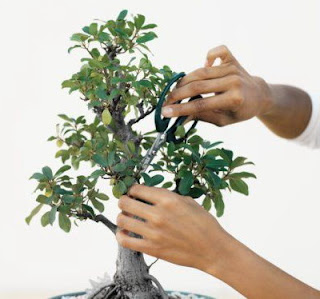
Trimming & Pruning - The main objective of trimming and pruning is to shape the bonsai into the desired form and to reduce growth above ground in order to maintain a balance with root growth.

The process of shaping begins when the tree is very young and is on going as it continues its growth. Trimming is accomplished by us ing a sharp scissors or shears. This traditional tool is called butterfly shears or bonsai shears and is used for removing foliage and light branches. When heavier branches are removed, we call it pruning and the tool to use is the concave cutter, for which there is no substitute. The concave cutter allows you to remove small, medium and even large branches without leaving any visible scars. Some trees such as the Juniper should be trimmed by using the thumb and index finger to remove new growth and to
prevent browning and a "sheared" appearance.

How to Prune Bonsai Tree
Read more »

Repotting

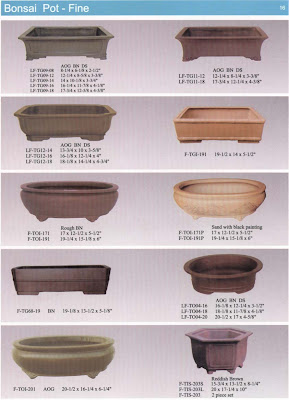
repotting bonsai, bonsai pot, pot care bonsai
Repotting - All potted plants will eventually outgrow their containers. While houseplants need to be
"potted-up", that is, placed in larger and larger containers, the miniaturization of a bonsai trees is maintained by keeping the roots confined to the small container. On average, repotting will be necessary every 3-5 years, but the tree should be removed from its container and its root system inspected once a year. If the roots form a circular ball around the perimeter of the pot, it is time to trim the roots and repot.

When repotting remember to:
• Use only bonsai soil
• Remove air pockets by working the soil down through the roots
• Do not remove more that 20% of the root system
• Repot during the appropriate repotting season
• Water well and keep out of the sun for a week or two
Read more »

Fertilizing

Fertilizing - Because bonsai trees are cultivated in limited amounts of soil, adequate feed is very important. As a general rule, a small amount of feed is given in the spring and a larger amount in the fall. Feed for bonsai should contain three principle ingredients; nitrogen, phosphoric acid, and potash. It is also a good idea to use a fertilizer containing "chelated" iron.

Water before fertilizing your tree and then apply at half the strength recommended by the brand's manufacturer. Rotate the use of brands since different manufacturers add different amounts of trace elements and minerals. You could also add Superthrive, which is a vitamin supplement to the fertilizer mix. You may find it simpler and easier to use slow release fertilizer granules (placed over the soil) whose nutrients are released with each watering.
Read more »

Misting

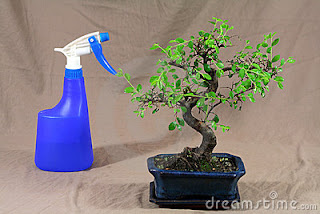
Misting - All trees grow in more humid conditions than our homes, offices and dormitories. So what can we do to provide this essential humidity ? Misting the tree is only beneficial for a short time, so what we recommend is to place the tree on a humidity tray and add water to the tray. As the water in the tray evaporates it creates a humid environment around the tree 24 hours a day. When the water in the tray is gone, add more water. It's a good idea to separate the pot from the water in the tray by adding some pebbles to the bottom of the tray. This will prevent any roots from sitting in the water.
Read more »

Watering Bonsai

watering bonsai, bonsai water tips, water technique bonsai
Watering bonsai, Unlike a houseplant, bonsai trees use a "free draining" type of soil because their roots cannot tolerate "wet feet". In addition, they are grown in significantly less soil and, therefore require more watering. Factors such as tree location, temperature, lighting conditions, quantity of soil used, and the changing seasons will determine the frequency of watering. You can get to know when your tree needs to be watered by observing the foliage, testing the soil with your index finger just below the surface, or just by the weight of the pot. (The drier the tree, the lighter it will feel.) To take the guesswork out of watering, an inexpensive moisture meter which works very much like a thermometer comes in handy. Insert it into the soil and the movement of the needle will tell you if it is time to water.

Rainwater is best for watering plants, but tap water that has stood for a few hours is adequate. In summer, trees should be watered in the early morning or late afternoon to avoid the midday heat. This will prevent the leaves of the finer bonsai from burning. In winter, water early to permit any excess to drain before the night frost. Plunging the pot into a bowl to soak is ideal for recently potted trees, small collections and for trees that have dried out. Be sure to drain properly, however!
Read more »

Sunlight

bonsai sunlight care, sunlight treatment bonsai
Sunlight, especially the ultra violet ray, affects the growth of trees. Therefore, except in special cases such as immediately after repotting, extensive trimming, etc, bonsai should be placed in a sunny location. Bright light will also work well but the tree should not be placed more than 12" away from the direct light source. An east, west or southern exposure works best. A northern exposure will require the use of "grow lights" which should remain on up to 16 hours each day and the lamp should not be more than 2 inches from the top of the tree.

Incandescent light is too hot and will not provide the various spectrum of light that is required to maintain your bonsai tree. If you do not have a window or light source that provides an east, west or southern exposure, be sure to select a bonsai tree that does well in lower lighting conditions.
Read more »

Purchasing A Tree

purchasing bonsai, bonsai tree price, bonsai pick tree
Purchasing A Tree - When buying a tree from a store during the summer, be sure to give it at least 2 weeks outside, avoiding heavy rain and high winds before displaying it indoors. If purchasing in winter, however, do not allow it to be exposed to frost for the rest of the season, as it will probably have begun to shoot. This is most important with deciduous trees, and while varieties of junipers are very hardy it is as well not to take any chances.

Most bonsai are hardy trees and shrubs whose natural habitat is out in the open. They are not permanent houseplants; and even semi-tropical trees should be placed outside when weather permits. During the summer the plant must be able to carry out the process of photosynthesis, and during winter it is resting and building up its strength for the coming spring. Too long in a warm room will persuade it that spring has arrived early and it will start budding. If this happens more than once, the tree will simply die of exhaustion.
Read more »

Popular Posts


Blog Archive

Powered by Blogger.

Copyright © ornamental plant All Rights Reserved • Design by Dzignine
best suv • audi suv • infiniti suv