banner

banner

How To Prune Bonsai Trees

bonsai pruning kit, scissor bonsai, kit for bonsai
How To Prune Bonsai Trees
Bonsai trees need training throughout their lives in order to:
1. Maintain the small size of a naturally large tree
2. Give the plant an appearance of age and maturity

Pruning Tools:
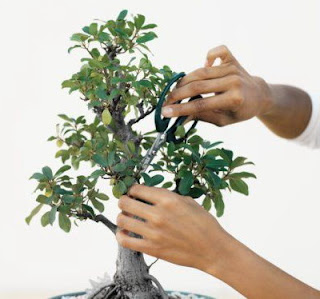
Pruning instruments should always be sharp and clean because blunt tools will leave a ragged stump, which could easily become a doorway for disease and pests. Heavy pruning cuts should be whittled down to a slight hollow in the trunk or branch in order to encourage the formation of a callous. Large cuts should be painted with protective paint.

When pruning a branch, try to make the cut just above a bud that is pointing in the direction you want the branch to grow. If the cut slopes downwards, then the water will run off and the chances of rot will be considerably lessened.
Read more »

Spider mites - they do hurt your bonsai

Spider mites - they do hurt your bonsai - Like any othe plant or tree, Bonsai will be susceptible to pests. If caught early and taken care properly, you can save your treasured tree.
Read more »

branch & leaves pruning - Bonsai

prune bonsai, pruning bonsai tree leaves


Main branch pruning:
Heavy pruning should be carried out in autumn, winter, or early spring, and is the major way of shaping a bonsai tree. The main priorities are to remove any branche that is too low at the front 1 any branch directly opposite another 2 any that creates a so-called cartwheel effect 3 and any that crosses the front or back to the other side of the tree. 4 Hollow out all stumps with a sharp knife 5.

General Pruning:
Throughout the growing season, cut back shoots of maples 1 zelkovas 2 and other broad-leaves to the first or second pair of leaves. Pinch out the tips of juniper shoots 3.With pines, 4 remove the center "candles" and pinch back the others.


Leaf Cutting:
Do this in early summer on deciduous trees that donot flower or fruit. Use sharp scissors to remove half of each leaf 1 on weak branches or trees, but all but the stalk 2 on strong wood. In a few weeks the stalk will drop and new small foliage and shoots will grow.


Read more »

A Guide To Bonsai Leaves

Trees & Leaves Suitable For Bonsai Culture - Since the aim of bonsai is to mirror in miniature the whole form of a mature wild tree, care is
needed when choosing varieties for bonsai culture, for the parts of the tree should always
remain reasonably in scale.
bonsai tree leaves,style leaves bonsai tree

A Guide To Bonsai Leaves
Here are the leaves of a number of common plants that you may find in a bonsai nursery.
1. Japanese black pine (Pinus thunbergii)
2. Short needled spruce
3. Yew (Taxus bacata)
4. Japanese cedar (Cryptomeria japonica)
5. Chinese juniper (Juniperus chinensis)
6. Trident maple (Acer trifidum)
7. Beech (Fagus sp)
8. Birch (Betula sp)
9. Chinese elm (Ulmus parvifolia)
10. Hornbeam (Carpinus sp)
11. Crab apple (Malus floribunda)
12. Various species of Prunus, including flowering cherries, peaches and apricots
13. Wisteria
14. Rock Cotoneaster (Cotoneaster horizontalis)
15. Small-leaved species of Azalea

Generally speaking, you should look for trees with small needles or leaves. The most popular evergreen trees for bonsai are pines, junipers and spruces.

Among the pines, short -needles varieties are preferable, although the Japanese black pine (Pinus thunbergii) can have its rather long needles reduced in size by removing all new growth every second year. Other popular varieties include Japanese cedar and yew.

Most deciduous trees can have their leaves dramatically reduced in size by not repotting too often and by leaf cutting. Again, varieties with fairly small leaves are generally preferred to begin with, and these include various varieties of maples, elms, hornbeams, beeches, and birches.

When choosing flowering and fruiting trees, bear in mind the size of both the leaves and of flowers and fruits. For instance, and normal apple tree will look very odd when it fruits, but a crabapple will look in scale with its tiny apples about the size of a small cherry. Many shrubs with small flowers and fruits, such as cotoneaster make excellent bonsai.
Read more »

Pests & Diseases

Pests & Diseases - As living trees, bonsai are susceptible to insect attacks and disease. Preventive and
corrective measures include:

• Keeping your bonsai in good health, since insects and bacteria tend to attack weak trees
• Giving your tree ample light, fresh air and ventilation
• Keeping the soil free of spent blooms and fallen leaves etc.

You may also use an insecticidal soap spray which is not harmful to humans or animals. This soap derivative, however, may require more than one application to control the insect population. It's also a good idea to use this spray weekly to prevent any attacks.
Read more »

Trimming & Pruning

trimming bonsai care, pruning tips bonsai, bonsai care tree
Trimming & Pruning - The main objective of trimming and pruning is to shape the bonsai into the desired form and to reduce growth above ground in order to maintain a balance with root growth.

The process of shaping begins when the tree is very young and is on going as it continues its growth. Trimming is accomplished by us ing a sharp scissors or shears. This traditional tool is called butterfly shears or bonsai shears and is used for removing foliage and light branches. When heavier branches are removed, we call it pruning and the tool to use is the concave cutter, for which there is no substitute. The concave cutter allows you to remove small, medium and even large branches without leaving any visible scars. Some trees such as the Juniper should be trimmed by using the thumb and index finger to remove new growth and to
prevent browning and a "sheared" appearance.

How to Prune Bonsai Tree
Read more »

Repotting

repotting bonsai, bonsai pot, pot care bonsai
Repotting - All potted plants will eventually outgrow their containers. While houseplants need to be
"potted-up", that is, placed in larger and larger containers, the miniaturization of a bonsai trees is maintained by keeping the roots confined to the small container. On average, repotting will be necessary every 3-5 years, but the tree should be removed from its container and its root system inspected once a year. If the roots form a circular ball around the perimeter of the pot, it is time to trim the roots and repot.

When repotting remember to:
• Use only bonsai soil
• Remove air pockets by working the soil down through the roots
• Do not remove more that 20% of the root system
• Repot during the appropriate repotting season
• Water well and keep out of the sun for a week or two
Read more »

Popular Posts


Blog Archive

Powered by Blogger.

Copyright © ornamental plant All Rights Reserved • Design by Dzignine
best suv • audi suv • infiniti suv